Showing posts with label Surah Yusuf (1-50). Show all posts

Saturday, December 26, 2015

Surah Yusuf Notes (46-53)

( Source: Ibn Kathir )


Yusuf's Interpretation of the King's Dream


(46) (He said): "O Yusuf (Joseph), the man of truth! Explain to us (the dream) of seven fat cows whom seven lean ones were devouring, and of seven green ears of corn, and (seven) others dry, that I may return to the people, and that they may know."

(O Yusuf, the man of truth! Explain to us..) and mentioned the king's dream to him.

(47) [(Yusuf (Joseph)] said: "For seven consecutive years, you shall sow as usual and that (the harvest) which you reap you shall leave in ears, (all) - except a little of it which you may eat.

This is when Yusuf, peace be upon him, told the interpretation of the dream, without criticizing the man for forgetting his request that he had made to him. Neither did he make a precondition that he be released before explaining the meaning. Rather, he said,

(For seven consecutive years, you shall sow as usual) `you will receive the usual amount of rain and fertility for seven consecutive years.' He interpreted the cows to be years, because cows till the land that produce fruits and vegetables, which represent the green ears of corn in the dream. He next recommended what they should do during these fertile years,

(and that (the harvest) which you reap you shall leave it in the ears, (all) except a little of it which you may eat.) He said, `Whatever you harvest during those seven fertile years, leave it in the ears so as to preserve it better. This will help the harvest stay healthy longer, except the amount that you need to eat, which should not be substantial. Stay away from extravagance, so that you use what remains of the harvest during the seven years of drought that will follow the seven fertile years.' This was represented by the seven lean cows that eat the seven fat cows. During the seven years of drought, they will eat from the harvest they collected during the seven fertile years, as represented by the dry ears of corn in the dream. Yusuf told them that during these years, the remaining ears will not produce anything and whatever they try to plant, will not produce any harvest, 

so he said,

(48) "Then will come after that, seven hard (years), which will devour what you have laid by in advance for them, (all) except a little of that which you have guarded (stored).

(which will devour what you have laid by in advance for them, (all) except a little of that which you have guarded (stored).) He delivered the good news to them that after the consecutive years of drought, there will come a fertile year, during which people will receive rain and the land will produce in abundance. The people will then press wine and oil as usual.

(49) "Then thereafter will come a year in which people will have abundant rain and in which they will press (wine and oil)."


The King investigates what happened between the Wife of the `Aziz, the Women in the City, and Yusuf


Allah narrates to us that when the king was conveyed the interpretation of his dream, he liked Yusuf's interpretation and felt sure that it was true. He realized the virtue of Prophet Yusuf, recognized his knowledge in the interpretation of dreams and valued his good conduct with his subjects in his country. 


(50) And the king said: "Bring him to me." But when the messenger came to him, [Yusuf (Joseph)] said: "Return to your lord and ask him, 'What happened to the women who cut their hands? Surely, my Lord (Allah) is Well-Aware of their plot.”

The king said,

(Bring him to me.) `Release him from prison and bring him to me.' When the king's emissary came to Yusuf and conveyed the news of his imminent release, Yusuf refused to leave the prison until the king and his subjects declare his innocence and the integrity of his honor, denouncing the false accusation that the wife of the `Aziz made against him. He wanted them to know that sending him to prison was an act of injustice and aggression, not that he committed an offense that warranted it.

(Return to your lord (i.e. king...) The Sunnah of our Prophet praised Prophet Yusuf and asserted his virtues, honor, elevated rank and patience, may Allah's peace and blessings be on him. 

In another narration collected by Ahmad from Abu Hurayrah, the Prophet said about Yusuf's statement, "...and ask him, `What happened to the women who cut their hands Surely, my Lord (Allah) is Well-Aware of their plot.'' If it was me, I would have accepted the offer rather than await my exoneration first.

The Musnad and the Two Sahihs recorded that Abu Hurayrah said that the Messenger of Allah said, (We are more liable to be in doubt than Ibrahim when he said,) (My Lord! Show me how You give life to the dead. ..)

(51) (The King) said (to the women): "What was your affair when you did seek to seduce Yusuf (Joseph)?" The women said: "Allah forbid! No evil know we against him!" The wife of Al-'Aziz said: "Now the truth is manifest (to all), it was I who sought to seduce him, and he is surely of the truthful."

(He said, "What was your affair when you did seek to seduce Yusuf'') The king gathered those women who cut their hands, while being hosted at the house of the wife of the `Aziz. He asked them all, even though he was directing his speech at the wife of his minister, the `Aziz in particular. He asked the women who cut their hands,

(What was your affair...), what was your story with regards to,

(when you did seek to seduce Yusuf) on the day of the banquet

(The women said: "Allah forbid! No evil know we against him!'') The women answered the king, `Allah forbid that Yusuf be guilty of this, for by Allah, we never knew him to do evil.' 

(The wife of the `Aziz said: "Now the truth has Hashasa...'') or the truth is manifest to all, according to Ibn `Abbas, Mujahid and others. Hashasa also means, `became clear and plain',


(52) [Then Yusuf (Joseph) said: "I asked for this enquiry] in order that he (Al-'Aziz) may know that I betrayed him not in secret. And, verily! Allah guides not the plot of the betrayers.

(in order that he may know that I betrayed him not in (his) absence. ) She said, `I admit this against myself so that my husband knows that I did not betray him in his absence and that adultery did not occur. I tried to seduce this young man and he refused, and I am admitting this so that he knows I am innocent,'

(And, verily, Allah guides not the plot of the betrayers. And I free not myself (from the blame).) She said, `I do not exonerate myself from blame, because the soul wishes and lusts, and this is what made me seduce him


(53) "And I free not myself (from the blame). Verily, the (human) self is inclined to evil, except when my Lord bestows His Mercy (upon whom He wills). Verily, my Lord is Oft-Forgiving, Most Merciful."

(Verily, the (human) self is inclined to evil, except when my Lord bestows His mercy (upon whom He wills).) whom Allah the Exalted wills to grant them immunity,

(Verily, my Lord is Oft-Forgiving, Most Merciful.) This is the most viable and suitable understanding for the continuity of the story and the meanings of Arabic speech. Al-Mawardi mentioned this in his Tafsir, in support of it, it was also preferred by Imam Abu Al-`Abbas Ibn Taymiyyah who wrote about it in detail in a separate work. It was said Yusuf peace be upon him is the one who said,

(in order that he (the `Aziz) may know that I betrayed him not) with his wife,

(in (his) absence).) until the end of Ayah (53) He said, `I sent back the emissary, so that the king would investigate my innocence and the `Aziz be certain that,

(I betrayed him not), with his wife,

(in (his) absence. And, verily, Allah guides not the plot of the betrayers.)' This is the only explanation presented by Ibn Jarir At-Tabari and Ibn Abi Hatim, but the first view is stronger and more obvious because it is a continuation of what the wife of the `Aziz said in the presence of the king. Yusuf was not present at all during this time, for he was released later on and brought to the king by his order.

Friday, December 25, 2015

Surah Yusuf Notes (41-45)

( Source: Ibn Kathir )


The Interpretation of the Dreams


(41) "O two companions of the prison! As for one of you, he (as a servant) will pour out wine for his lord (king or master) to drink; and as for the other, he will be crucified and birds will eat from his head. Thus is the case judged concerning which you both did inquire."

Yusuf said,

(O two companions of the prison! As for one of you, he will pour out wine for his master to drink;) to the man who saw in a dream that he was pressing wine. He did not direct this speech at him, however, so that to lessen the grief of the other person. This is why he made his statement indirect.

(and as for the other, he will be crucified and birds will eat from his head.) which is the interpretation of the other man's dream in which he saw himself carrying bread above his head. Yusuf told them that the decision about their matter has already been taken and it shall come to pass. This is because the dream is tied to a bird's leg, as long as it is not truthfully interpreted. If it is interpreted, then it becomes a reality. 

Ath-Thawri said that `Imarah bin Al-Qa`qa` narrated that Ibrahim said that `Abdullah bin Mas`ud said, "When they said what they said to him, and he explained their dreams to them, they replied, `We did not see anything at all.' This is when he said,

(Thus is the case judged concerning which you both did inquire.)'' The understanding in this is that he who claims that he saw a dream and was given its interpretation, then he will be tied to its interpretation, and Allah has the best knowledge. 

There is an honorable Hadith that Imam Ahmad collected from Mu`awiyah bin Haydah that the Prophet said, (The dream is tied to a bird's leg, as long as it is not interpreted. If it is interpreted, it becomes a reality.)


Yusuf asks the King's Distiller to mention Him to the King

(42) And he said to the one whom he knew to be saved: "Mention me to your lord (i.e. your king, so as to get me out of the prison)." But Shaitan (Satan) made him forget to mention it to his Lord [or Satan made [(Yusuf (Joseph)] to forget the remembrance of his Lord (Allah) as to ask for His Help, instead of others]. So [Yusuf (Joseph)] stayed in prison a few (more) years.

Yusuf knew that the distiller would be saved. So discretely, so that the other man's suspicion that he would be crucified would not intensify, he said,

(Mention me to your King.) asking him to mention his story to the king. That man forgot Yusuf's request and did not mention his story to the king, a plot from the devil, so that Allah's Prophet would not leave the prison. This is the correct meaning of,

(But Shaytan made him forget to mention it to his master.) that it refers to the man who was saved. As was said by Mujahid, Muhammad bin Ishaq and several others. As for, `a few years', or, Bida` in Arabic, it means between three and nine, according to Mujahid and Qatadah. Wahb bin Munabbih said, "Ayyub suffered from the illness for seven years, Yusuf remained in prison for seven years and Bukhtanassar (Nebuchadnezzar - Chaldean king of Babylon) was tormented for seven years.''

The Dream of the King of Egypt

The King of Egypt had a dream that Allah the Exalted made a reason for Yusuf's release from prison, with his honor and reputation preserved. When the king had this dream, he was astonished and fearful and sought its interpretation. He gathered the priests, the chiefs of his state and the princes and told them what he had seen in a dream, asking them to interpret it for him.
(43) And the king (of Egypt) said: "Verily, I saw (in a dream) seven fat cows, whom seven lean ones were devouring - and of seven green ears of corn, and (seven) others dry. O notables! Explain to me my dream, if it be that you can interpret dreams."

(44) They said: "Mixed up false dreams and we are not skilled in the interpretation of dreams."

They did not know its interpretation and as an excuse, they said,

(Mixed up false dreams), which you saw,

(and we are not skilled in the interpretation of dreams.) They said, had your dream been a vision rather than a mixed up false dream, we would not have known its interpretation. The man who was saved from the two, who were Yusuf's companions in prison, remembered. Shaytan plotted to make him forget the request of Yusuf, to mention his story to the king. Now, years later, he remembered after forgetfulness and said to the king and his entourage,


(45) Then the man who was released (one of the two who were in prison), now at length remembered and said: "I will tell you its interpretation, so send me forth."

(I will tell you its interpretation,) he interpretation of this dream,

(so send me forth.) to the prison, to Yusuf, the man of truth. So they sent him, and he said to Yusuf,

(O Yusuf, the man of truth! Explain to us..) and mentioned the king's dream to him.

Sunday, December 20, 2015

Surah Yusuf Notes (27- 35)

( Source: Ibn Kathir )


(27) "But if it be that his shirt is torn from the back, then she has told a lie and he is speaking the truth!"


(But if it be that his shirt is torn from the back, then she has told a lie and he is speaking the truth!) Had Yusuf run away from her, and this is what truly happened, and she set in his pursuit, she would have held to his shirt from the back to bring him back to her, thus tearing his shirt from the back.

(28) So when he (her husband) saw his [(Yusuf's (Joseph)] shirt torn at the back; (her husband) said: "Surely, it is a plot of you women! Certainly mighty is your plot!

(So when he saw his ﴿Yusuf's﴾ shirt torn at the back,) indicates that when her husband became certain that Yusuf was telling the truth and that his wife was lying when she heralded the accusation of betrayal at Yusuf,

(he said: "Surely, it is a plot of you women!...'') He said, `This false accusation and staining the young man's reputation is but a plot of many that you, women, have,'

(Certainly mighty is your plot!) The `Aziz ordered Yusuf, peace be upon him, to be discrete about what happened,

(29) "O Yusuf (Joseph)! Turn away from this! (O woman!) Ask forgiveness for your sin. Verily, you were of the sinful."

(O Yusuf ! Turn away from this!), do not mention to anyone what has happened,

(And ask forgiveness for your sin, ) addressing his wife. The `Aziz was an easy man, or gave excuse to his wife because she saw in Yusuf an appeal she could not resist. He said to her, `Ask forgiveness for your sin, the evil desire that you wanted to satisfy with this young man, and then inventing false accusations about him,'

The News reaches Women in the City, Who also plot against Yusuf


(30) And women in the city said: "The wife of Al-'Aziz is seeking to seduce her (slave) young man, indeed she loves him violently; verily we see her in plain error."

Allah states that the news of what happened between the wife of the `Aziz and Yusuf spread in the city, that is, Egypt, and people talked about it,

(And women in the city said...), such as women of chiefs and princes said, while admonishing and criticizing the wife of the `Aziz,

(The wife of the `Aziz is seeking to seduce her (slave) young man,), she is luring her servant to engage in sin with her,

(indeed she loves him violently;), her love for him filled her heart and engulfed it,

(verily, we see her in plain error.), by loving him and trying to seduce him.


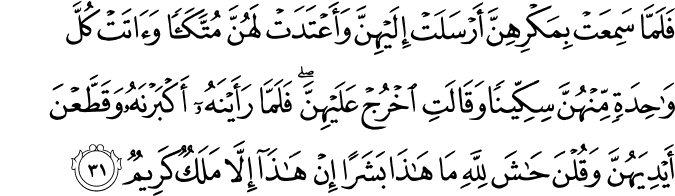
(31) So when she heard of their accusation, she sent for them and prepared a banquet for them; she gave each one of them a knife (to cut the foodstuff with), and she said [(to Yusuf (Joseph)]: "Come out before them." Then, when they saw him, they exalted him (at his beauty) and (in their astonishment) cut their hands. They said: "How perfect is Allah (or Allah forbid)! No man is this! This is none other than a noble angel!"

(So when she heard of their accusation,) especially their statement, "indeed she loves him violently.'' Muhammad bin Ishaq commented, "They heard of Yusuf's beauty and wanted to see him, so they said these words in order to get a look at him. '' This is when,

(she sent for them), invited them to her house,

(and prepared a banquet for them.) Ibn `Abbas, Sa'id bin Jubayr, Mujahid, Al-Hasan, As-Suddi and several others commented that she prepared a sitting room which had couches, pillows ﴿to recline on﴾ and food that requires knives to cut, such as citron. This is why Allah said next,

(and she gave each one of them a knife), as a part of her plan of revenge for their plot to see Yusuf,

(and she said ﴿to Yusuf﴾: "Come out before them.''), for she had asked him to stay somewhere else in the house,

(Then, when) he went out and,

(they saw him, they exalted him) they thought highly of him and were astonished at what they saw. They started cutting their hands in amazement at his beauty, while thinking that they were cutting the citron with their knives. Therefore, they injured their hands with the knives they were holding, according to several reports of Tafsir. Others said that after they ate and felt comfortable, and after having placed citron in front of them, giving each one of them a knife, the wife of the `Aziz asked them, "Would you like to see Yusuf'' They said, "Yes.'' So she sent for him to come in front of them and when they saw him, they started cutting their hands. She ordered him to keep coming and going, so that they saw him from all sides, and he went back in while they were still cutting their hands. When they felt the pain, they started screaming and she said to them, "You did all this from one look at him, so how can I be blamed

(They said: "How perfect is Allah! No man is this! This is none other than a noble angel!'') They said to her, "We do not blame you anymore after the sight that we saw.'' They never saw anyone like Yusuf before, for he, peace be upon him, was given half of all beauty.

 An authentic Hadith stated that the Messenger of Allah passed by Prophet Yusuf, during the Night of Isra' in the third heaven and commented, He was given a half of all beauty.) Mujahid and others said ﴿they said﴾: "We seek refuge from Allah,''

(No man is this!) They said next,


 (32) She said: "This is he (the young man) about whom you did blame me (for his love), and I did seek to seduce him, but he refused. And now if he refuses to obey my order, he shall certainly be cast into prison, and will be one of those who are disgraced."

("This is none other than a noble angel!'' She said: "This is he (the young man) about whom you did blame me...'') She said these words to them so that they excuse her behavior, for a man who looks this beautiful and perfect, is worthy of being loved, she thought. 

(and I did seek to seduce him, but he refused) to obey me. Some scholars said that when the women saw Yusuf's beauty, she told them about his inner beauty that they did not know of, being chaste and beautiful from the inside and outside. She then threatened him,

(And now if he refuses to obey my order, he shall certainly be cast into prison, and will be one of those who are disgraced.) This is when Prophet Yusuf sought refuge with Allah from their evil and wicked plots,


(33) He said:"O my Lord! Prison is more to my liking than that to which they invite me. Unless You turn away their plot from me, I will feel inclined towards them and be one (of those who commit sin and deserve blame or those who do deeds) of the ignorants."

(He said: "O my Lord! Prison is dearer to me than that to which they invite me...'') illegal sexual acts,

(Unless You turn away their plot from me, I will feel inclined towards them) Yusuf invoked Allah: If You abandon me and I am reliant on myself, then I have no power over myself, nor can I bring harm or benefit to myself, except with Your power and will. Verily, You are sought for each and everything, and our total reliance is on You Alone for each and everything. Please, do not abandon me and leave me to rely on myself, for then,

("I will feel inclined towards them and be one of the ignorant.'' So his Lord answered his invocation) Yusuf, peace be upon him, was immune from error by Allah's will, and He saved him from accepting the advances of the wife of the `Aziz'. He preferred prison, rather than accept her illicit call. This indicates the best and most perfect grade in this case, for Yusuf was youthful, beautiful and full of manhood. His master's wife was calling him to herself, and she was the wife of the `Aziz of Egypt. She was also very beautiful and wealthy, as well as having a great social rank. He refused all this and preferred prison, for he feared Allah and hoped to earn His reward.

 It is recorded in the Two Sahihs that the Messenger of Allah said, (Allah will give shade to seven, on the Day when there will be no shade but His: A just ruler, a youth who has been brought up in the worship of Allah, a man whose heart is attached to the Masjid, from the time he goes out of the Masjid until he gets back to it, two persons who love each other only for Allah's sake and they meet and part in Allah's cause only, a man who gives charitable gifts so secretly that his left hand does not know what his right hand has given, a man who refuses the call of a charming woman of noble birth for illicit intercourse with her and says: "I am afraid of Allah, and a person who remembers Allah in seclusion and his eyes are then flooded with tears.'')


(34) So his Lord answered his invocation and turned away from him their plot. Verily, He is the All-Hearer, the All-Knower.

Yusuf is imprisoned without Justification


(35) Then it appeared to them, after they had seen the proofs (of his innocence) to imprison him for a time.

Allah says, `Then it occurred to them that it would be in their interest to imprison Yusuf for a time, even after they were convinced of his innocence and saw the proofs of his truth, honesty and chastity.' It appears, and Allah knows best, that they imprisoned him after the news of what happened spread. They wanted to pretend that Yusuf was the one who tried to seduce the `Aziz's wife and that they punished him with imprisonment. This is why when the Pharaoh asked Yusuf to leave jail a long time afterwards, he refused to leave until his innocence was acertained and the allegation of his betrayal was refuted. When this was successfully achieved, Yusuf left the prison with his honor intact, peace be upon him.


Saturday, December 19, 2015

Surah Yusuf Notes (22-26)

( Source: Ibn Kathir )


 (22) And when he [Yusuf (Joseph)] attained his full manhood, We gave him wisdom and knowledge (the Prophethood), thus We reward the Muhsinun (doers of good)


(And when he attained), in reference to Prophet Yusuf, peace be upon him,

(his full manhood), sound in mind and perfect in body,

(We gave him wisdom and knowledge), which is the prophethood that Allah sent him with for the people he lived among,

(thus We reward the doers of good.) because Yusuf used to do good in the obedience of Allah the Exalted.

Wife of the `Aziz loves Yusuf and plots against Him

Allah states that the wife of the `Aziz of Egypt, in whose house Yusuf resided and whose husband recommended that she takes care of him and be generous to him, tried to seduce Yusuf! She called him to do an evil act with her, because she loved him very much. Yusuf was very handsome, filled with manhood and beauty. She beautified herself for him, closed the doors and called him,

(23) And she, in whose house he was, sought to seduce him (to do an evil act), she closed the doors and said: "Come on, O you." He said: "I seek refuge in Allah (or Allah forbid)! Truly, he (your husband) is my master! He made my stay agreeable! (So I will never betray him). Verily, the Zalimun (wrong and evil-doers) will never be successful."

(and (she) said: "Come on, O you.'') But he categorically refused her call,
﴿هَيْتَ لَكَ﴾
(Hayta Laka), whereby Ibn `Abbas, Mujahid and several other scholars said that it means that she was calling him to herself. Al-Bukhari said; "Ikrimah said that,

(Hayta Laka') means, `come on, O you', in the Aramaic language.'' Al-Bukhari collected this statement from `Ikrimah without a chain of narration. Other scholars read it with the meaning, `I am ready for you'. Ibn `Abbas, Abu `Abdur-Rahman As-Sulami, Abu Wa'il, `Ikrimah and Qatadah were reported to have read this part of the Ayah this way and explained it in the manner we mentioned, as `I am ready for you'.

(He said: "I seek refuge in Allah! Truly, he is my Rabb! He made my living in a great comfort!'') as they used to call the chief and master a `Rabb', Yusuf said to her, `your husband is my master who provided me with comfortable living and was kind to me, so I will never betray him by committing immoral sins with his wife,'

(Verily, the wrongdoers will never be successful.)


(24) And indeed she did desire him and he would have inclined to her desire, had he not seen the evidence of his Lord. Thus it was, that We might turn away from him evil and illegal sexual intercourse. Surely, he was one of Our chosen, guided slaves.

(And indeed she did desire him, and he would have inclined to her desire, had he not seen the evidence of his Lord. Thus it was, that We might turn away from him evil and immoval sins. Surely, he was one of Our Mukhlasin servants.) This is about the thoughts that cross the mind, according to Al-Baghawi who mentioned this opinion from some of the analysts. 


 Al-Baghawi next mentioned here a Hadith that he narrated from `Abdur Razzaq, from Ma`mar, from Hammam, from Abu Hurayrah, from the Messenger of Allah ,

(Allah the Exalted said, `If my slave intends to perform a good deed, then record it for him as one good deed; if he performs it, then record it for him multiplied ten folds. If he intends to commit an evil act but did not commit it, then record it for him as one good deed, if he left it for My sake. But if he commits it, then write it as one evil deed.') 

This Hadith was also collected in the Two Sahihs using various wording, this is one of them. It was also reported that the Ayah means that Yusuf was about to beat her. As for the evidence that Yusuf saw at that moment, there are conflicting opinions to what it was.

 Ibn Jarir At-Tabari said, "The correct opinion is that we should say that he saw an Ayah from among Allah's Ayat that repelled the thought that crossed his mind. This evidence might have been the image of Ya`qub, or the image of an angel, or a divine statement that forbade him from doing that evil sin, etc. There are no clear proofs to support any of these statements in specific, so it should be left vague, as Allah left it.

(Thus it was, that We might turn away from him evil and immoral sins.) means, `Just as We showed him the evidence that turned him away from that sin, We save him from all types of evil and illegal sexual activity in all his affairs,' because,

(Surely, he was one of Our Mukhlasin servants.) meaning, chosen, purified, designated, appointed and righte- ous. May Allah's peace and blessings be on him.''

(25) So they raced with one another to the door, and she tore his shirt from the back. They both found her lord (i.e. her husband) at the door. She said: "What is the recompense (punishment) for him who intended an evil design against your wife, except that he be put in prison or a painful torment?"

(What is the recompense (punishment) for him who intended an evil design against your wife...), in reference to illegal sexual intercourse,

(except that he be put in prison)

(or a painful torment) tormented severely with painful beating. Yusuf did not stand idle, but he declared the truth and exonerated himself from the betrayal she accused him of,


(26) He [Yusuf (Joseph)] said: "It was she that sought to seduce me," - and a witness of her household bore witness (saying): "If it be that his shirt is torn from the front, then her tale is true and he is a liar!


(He ﴿Yusuf﴾ said), in truth and honesty,

(It was she that sought to seduce me), and mentioned that she pursued him and pulled him towards her until she tore his shirt.

(And a witness of her household bore witness (saying): "If it be that his shirt is torn from the front...''), not from the back,

(then her tale is true) that he tried to commit an illegal sexual act with her. Had he called her to have sex with him and she refused, she would have pushed him away from her and tore his shirt from the front.

There is a difference of opinion over the age and gender of the witness mentioned here. `Abdur-Razzaq recorded that Ibn `Abbas said that,

(and a witness of her household bore witness) "was a bearded man,'' meaning an adult male. Ath-Thawri reported that Jabir said that Ibn Abi Mulaykah said that Ibn `Abbas said, "He was from the king's entourage.'' Mujahid, `Ikrimah, Al-Hasan, Qatadah, As-Suddi, Muhammad bin Ishaq and others also said that the witness was an adult male. Al-`Awfi reported that Ibn `Abbas said about Allah's statement,

(and a witness of her household bore witness) "He was a babe in the cradle. '' Similar was reported from Abu Hurayrah, Hilal bin Yasaf, Al-Hasan, Sa`id bin Jubayr and Ad-Dahhak bin Muzahim, that the witness was a young boy who lived in the `Aziz's house. Ibn Jarir At-Tabari preferred this view. 


Friday, December 18, 2015

Surah Yusuf Notes (19-21)

( Source: Ibn Kathir )


Yusuf is Rescued from the Well and sold as a Slave


Allah narrates what happened to Yusuf, peace be upon him, after his brothers threw him down the well and left him in it, alone, where he remained for three days, according to Abu Bakr bin `Ayyash. Muhammad bin Ishaq said, "After Yusuf's brothers threw him down the well, they remained around the well for the rest of the day to see what he might do and what would happen to him. Allah sent a caravan of travelers that camped near that well, and they sent to it the man responsible for drawing water for them. When he approached the well, he lowered his bucket down into it, Yusuf held on to it and the man rescued him and felt happy.

 (19) And there came a caravan of travellers; they sent their water-drawer, and he let down his bucket (into the well). He said: "What good news! Here is a boy." So they hid him as merchandise (a slave). And Allah was the All-Knower of what they did.

("What good news! Here is a boy.'')

Al-`Awfi reported that Ibn `Abbas commented, "Allah's statement,

(So they hid him as merchandise), is in reference to Yusuf's brothers, who hid the news that he was their brother. Yusuf hid this news for fear that his brothers might kill him and preferred to be sold instead. Consequently, Yusuf's brothers told the water drawer about him and that man said to his companions,

("What good news! Here is a boy.''), a slave whom we can sell. Therefore, Yusuf's own brothers sold him.'' Allah's statement,

(And Allah was the All-Knower of what they did. ) states that Allah knew what Yusuf's brothers, and those who bought him, did. He was able to stop them and prevent them from committing their actions, but out of His perfect wisdom He decreed otherwise. He let them do what they did, so that His decision prevails and His appointed destiny rules,

(Surely, His is the creation and commandment. Blessed is Allah, the Lord of the all that exists!) ﴿7:54﴾ 

This reminds Allah's Messenger Muhammad , that Allah has perfect knowledge in the persecution that his people committed against him and that He is able to stop them. However, He decided to give them respite, then give Muhammad the victory and make him prevail over them, just as He gave Yusuf victory and made him prevail over his brothers.


(20) And they sold him for a low price, - for a few Dirhams (i.e. for a few silver coins). And they were of those who regarded him insignificant.


(And they sold him for a Bakhs price, - for a few Dirhams) in reference to Yusuf's brothers selling him for a little price, according to Mujahid and `Ikrimah. `Bakhs' means decreased, just as Allah the Exalted said in another Ayah,
﴿فَلاَ يَخَافُ بَخْساً وَلاَ رَهَقاً﴾
(shall have no fear, either of a Bakhs (a decrease in the reward of his good deeds) or a Rahaq (an increase in the punishment for his sins).) ﴿72:13﴾ 

meaning that Yusuf's brothers exchanged him for a miserably low price. Yet, he was so insignificant to them that had the caravan people wanted him for free, they would have given him for free to them.

(And they sold him), is in reference to Yusuf's brothers. They sold Yusuf for the lowest price, as indicated by Allah's statement next,

(for a few Dirhams), twenty Dirhams, according to `Abdullah bin Mas`ud. Similar was said by Ibn `Abbas, As-Suddi, Qatadah and `Atiyah Al-`Awfi, who added that they divided the Dirhams among themselves, each getting two Dirhams. 

(And they were of those who regarded him insignificant.) "Because they had no knowledge of his prophethood and glorious rank with Allah, the Exalted and Most Honored.''


Yusuf in Egypt

Allah mentions the favors that He granted Yusuf, peace be on him, by which He made the man from Egypt who bought him, take care of him and provide him with a comfortable life. He also ordered his wife to be kind to Yusuf and had good hopes for his future, because of his firm righteous behavior. 

(21) And he (the man) from Egypt who bought him, said to his wife: "Make his stay comfortable, may be he will profit us or we shall adopt him as a son." Thus did We establish Yusuf (Joseph) in the land, that We might teach him the interpretation of events. And Allah has full power and control over His Affairs, but most of men know not.

(Make his stay comfortable, maybe he will profit us or we shall adopt him as a son.) The man who bought Yusuf was the minister of Egypt at the time, and his title was `Aziz'. Abu Ishaq narrated that Abu `Ubaydah said that `Abdullah bin Mas`ud said, "Three had the most insight: the `Aziz of Egypt, who said to his wife,

(Make his stay comfortable...),

 Allah said next that just as He saved Yusuf from his brothers,

(Thus did We establish Yusuf in the land), in reference to Egypt,

(that We might teach him the interpretation of events.) the interpretation of dreams

(And Allah has full power and control over His affairs,) if He wills something, then there is no averting His decision, nor can it ever be stopped or contradicted. Rather, Allah has full power over everything and everyone else. Sa`id bin Jubayr said while commenting on Allah's statement,

(And Allah has full power and control over His affairs,) "He does what ever He wills.'' Allah said,

(but most of men know not.) meaning, have no knowledge of Allah's wisdom with regards to His creation, compassion and doing what He wills. 

Thursday, December 17, 2015

Surah Yusuf Notes (11-18)

( Source: Ibn Kathir )


Yusuf's Brothers ask for Their Father's Permission to take Yusuf with Them


(11) They said, "O our father, why do you not entrust us with Joseph while indeed, we are to him sincere counselors?

When Yusuf's brothers agreed to take him and throw him down the well, taking the advice of their elder brother Rubil, they went to their father Ya`qub, peace be upon him. They said to him, "Why is it that you,

(do not trust us with Yusuf though we are indeed his well-wishers).'' They started executing their plan by this introductory statement, even though they really intended its opposite, out of envy towards Yusuf for being loved by his father. 

They said,

(12) Send him with us tomorrow that he may eat well and play. And indeed, we will be his guardians.

"(Send him with us) tomorrow so that we all enjoy ourselves and play.

(and verily, we will take care of him.), we will protect him and ensure his safety for you.

Ya`qub's Answer to Their Request


(13) [Jacob] said, "Indeed, it saddens me that you should take him, and I fear that a wolf would eat him while you are of him unaware."

Allah narrates to us that His Prophet Ya`qub said to his children, in response to their request that he send Yusuf with them to the desert to tend their cattle,

(Truly, it saddens me that you should take him away.) He said that it was hard on him that he be separated from Yusuf for the duration of their trip, until they came back. This demonstrates the deep love that Ya`qub had for his son, because he saw in Yusuf great goodness and exalted qualities with regards to conduct and physical attractiveness associated with the rank of prophethood. May Allah's peace and blessings be on him. 

(I fear lest a wolf should devour him, while you are careless of him.) He said to them, `I fear that you might be careless with him while you are tending the cattle and shooting, then a wolf might come and eat him while you are unaware.' They heard these words from his mouth and used them in their response for what they did afterwards. 

They also gave a spontaneous reply for their father's statement, saying,

(14) They said, " If a wolf should eat him while we are a [strong] clan, indeed, we would then be losers."

(If a wolf devours him, while we are an `Usbah, then surely, we are the losers.) They said, `If a wolf should attack and devour him while we are all around him in a strong group, then indeed we are the losers and weak.'

Yusuf is thrown in a Well


(15) So when they took him [out] and agreed to put him into the bottom of the well... But We inspired to him, "You will surely inform them [someday] about this affair of theirs while they do not perceive [your identity]."

Allah says that when Yusuf's brothers took him from his father, after they requested him to permit that,

(they all agreed to throw him down to the bottom of the well,) This part of the Ayah magnifies their crime, in that it mentions that they all agreed to throw him to the bottom of the well. This was their intent, yet when they took him from his father, they pretended otherwise, so that his father sends him with a good heart and feeling at ease and comfortable with his decision. It was reported that Ya`qub, peace be upon him, embraced Yusuf, kissed him and supplicated to Allah for him when he sent him with his brothers. As-Suddi said that the time spent between pretending to be well-wishers and harming Yusuf was no longer than their straying far from their father's eyes. They then started abusing Yusuf verbally, by cursing, and harming him by beating. When they reached the well that they agreed to throw him in, they tied him with rope and lowered him down. When Yusuf would beg one of them, he would smack and curse him. When he tried to hold to the sides of the well, they struck his hand and then cut the rope when he was only half the distance from the bottom of the well. He fell into the water and was submerged. However, he was able to ascend a stone that was in the well and stood on it. 

 Allah said next,

(and We revealed to him: "Indeed, you shall (one day) inform them of this their affair, when they know (you) not. '') In this Ayah, Allah mentions His mercy and compassion and His compensation and relief that He sends in times of distress. Allah revealed to Yusuf, during that distressful time, in order to comfort his heart and strengthen his resolve, `Do not be saddened by what you have suffered. Surely, you will have a way out of this distress and a good end, for Allah will aid you against them, elevate your rank and raise your grade. Later on, you will remind them of what they did to you.

(when they know not.) "Ibn `Abbas commented on this Ayah, "You will remind them of this evil action against you, while they are unaware of your identity and unable to recognize you.''

Yusuf's Brothers try to deceive Their Father


Allah narrates to us the deceit that Yusuf's brothers resorted to, after they threw him to the bottom of the well. They went back to their father, during the darkness of the night, crying and showing sorrow and grief for losing Yusuf. They started giving excuses to their father for what happened to Yusuf, falsely claiming that,

(16) And they came to their father at night, weeping.

(17) They said, "O our father, indeed we went racing each other and left Joseph with our possessions, and a wolf ate him. But you would not believe us, even if we were truthful."
(18) And they brought upon his shirt false blood. [Jacob] said, "Rather, your souls have enticed you to something, so patience is most fitting. And Allah is the one sought for help against that which you describe."

(We went racing with one another), or had a shooting competition,

(and left Yusuf by our belongings), guarding our clothes and luggage,

(and a wolf devoured him), which is exactly what their father told them he feared for Yusuf and warned against. They said next,

(but you will never believe us even when we speak the truth.) They tried to lessen the impact of the grave news they were delivering. They said, `We know that you will not believe this news, even if you consider us truthful. So what about when you suspect that we are not truthful, especially since you feared that the wolf might devour Yusuf and that is what happened' Therefore, they said, `You have reason not to believe us because of the strange coincidence and the amazing occurrence that happened to us. '

(And they brought his shirt stained with false blood.) on it, to help prove plot that they all agreed on. They slaughtered a sheep, according to Mujahid, As-Suddi and several other scholars, and stained Yusuf's shirt with its blood. They claimed that this was the shirt Yusuf was wearing when the wolf devoured him, being stained with his blood. But, they forgot to tear the shirt, and this is why Allah's Prophet Ya`qub did not believe them. Rather, he told them what he felt about what they said to him, thus refusing their false claim,

(Nay, but your ownselves have made up a tale. So (for me) patience is most fitting.) Ya`qub said, `I will firmly observe patience for this plot on which you agreed, until Allah relieves the distress with His aid and compassion,

(And it is Allah (alone) Whose help can be sought against that which you describe.), against the lies and unbelievable incident that you said had occurred.'

Surah Al Baqarah Notes (8-16)

Source: Ibn Kathir

Popular Posts